Showing posts with label News from parliament. Show all posts

Friday, 14 February 2014

Our underground message to MPs

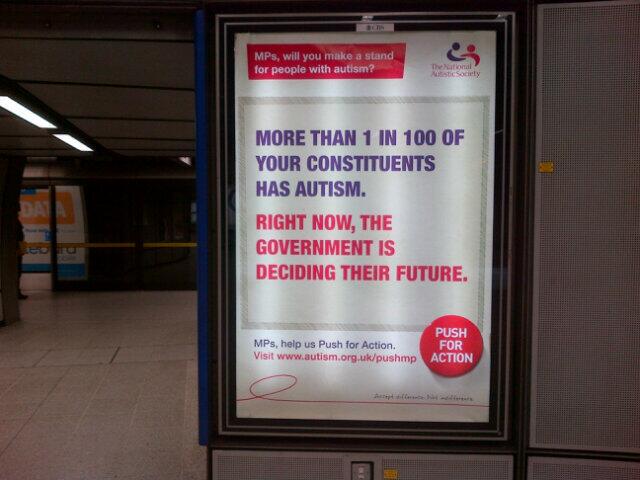
If you’re passing through Westminster tube station, look out for our timely message to MPs…


We know a lot of MPs arrive to work at Westminster tube every day, so we thought we'd catch them on their commute with this eye-catching poster right in the heart of the station. Our poster reminds them that this is a critical moment in the Push For Action campaign - and they need to take action.

The Government will be publishing the new adult autism strategy on World Autism Awareness Day, 2nd April 2014, so we need as many MPs as possible to be speaking up about autism in parliament and asking questions of the Health Minister, Norman Lamb, over the coming weeks.

You can do your bit by asking your MP to speak up for you by taking this simple online action: https://e-activist.com/ea-action/action?ea.client.id=10&ea.campaign.id=24705&ea.tracking.id=9ebfc811


Tuesday, 21 January 2014

We welcome the publication of NICE Quality Standard on autism

The National Institute for Health and Care Excellence (NICE) has today published its Quality Standard on autism setting out what good services for children and adults with autism should look like. 
Local councils and the NHS will now need to look at whether services are meeting relevant areas of this standard. This should mean the specific needs of people with autism are taken in to account in the design of services. The standard can also be used by people with autism and their parents/carers as information about what high-quality care or services should include. 
The need for a Quality Standard was a key recommendation of our You Need to Know campaign for improving child and adolescent mental health services (CAMHS) for children with autism.

The Quality Standard sets eight measures to assess the quality care for people with autism, which include:
  • diagnosis should happen within three months of referral to an autism team
  • whilst being diagnosed, people must be assessed for comorbid mental or physical health issues
  • those with a diagnosis should have a personalised plan, developed between the individual, parents/carers and the local autism team
  • everyone with autism should have a key worker to support delivery of the personalised plan
  • People with autism should not be prescribed medication to address core features of autism
  • those who develop behaviour that challenges should be assessed for possible triggers, including physical health conditions, mental health problems and environmental factors
  • people with autism and behaviour that challenges should not be offered antipsychotic medication for the behaviour unless it is being considered because other interventions are insufficient or cannot be delivered because of the severity of the behaviour.

Mark Lever, Chief Executive of The National Autistic Society, said:
With the right support at the right time, people with autism can live rewarding and fulfilling lives which is why we campaigned hard to secure this Quality Standard.
The first step to getting the right support is having timely access to diagnosis so speeding up the process will have a significant impact on the lives of thousands of people with autism in England, many of whom have waited or are waiting, to obtain this critical milestone.
The Standard recognises that people with autism can also have mental or physical health issues. Professionals need to understand that all of a person’s issues need to be looked at when providing support and so services should rightly be judged on their ability to do just that.  
This Standard will also allow for services to be measured on how they respond and treat challenging behaviour and makes it clear that people with autism should not be prescribed medication to address the core features of the condition.
People with autism have campaigned long and hard for their needs to be addressed when professionals are designing support and services: measuring progress against this Standard will help to ensure that this happens.”

Tuesday, 14 January 2014

MPs quiz Care Minister on key campaign demands

MPs continued to maintain pressure on the Department of Health to meet its commitments under the Autism Act, as the National Autistic Society’s ‘Push for Action’ campaign was raised in Parliament during the Health questions session.

Angela Smith MP asked the Secretary of State for Health when he expected the revised adult autism strategy to be published. Responding on behalf of the Government, Care Minister Norman Lamb said that the review and revised strategy would be published at the end of March 2014.

Ms Smith also asked the Minister if he would consider the NAS’s proposals to introduce an ‘innovation fund’ for local councils to encourage the implementation of new and innovative models of service provision for people with autism. The Minister commended the Push for Action campaign and the work of the NAS. He confirmed that the Department was seriously considering these proposals and that they have ‘real merit.’

Chair of the APPG on Autism, Robert Buckland MP also asked the Minister how he plans to use the review to bring forward programmes to increase autism awareness amongst the general public. The Minister accepted that general awareness of autism is still low but that the strategy review provided an opportunity to ensure that implementation makes a real difference on the ground for people with autism.

The Minister’s comments were encouraging, particularly with regards to our proposals for an innovation fund. We are also glad that the Department of Health recognises that there is still much more work to be done to ensure that the spirit of the Autism Act is maintained in the revised strategy and that people with autism get the support that they need. 

Monday, 11 November 2013

Why Emma is pushing for action

Emma, who has a sibling with autism, came to our Push for Action reception in parliament in October. Here, she writes about her experiences of the event and why she is supporting the campaign:


On the 15th October I had the fantastic opportunity of supporting the National Autistic Society in their ‘Push for Action’ campaign in Parliament. As my severely autistic brother has gone through a traumatic experience from children’s  to adult services, I  like many others across the country,  understand the urgency to improve local services for adults with autism. 

The parliamentary reception began with speeches from other campaigners. I was really inspired by the enlightenment of Chris, an adult with autism, sharing his experience of what it is like living with autism.  This was followed by Sam and her brother, Indi, who made an emotional speech of what they have gone through and what needs to be changed. It was great to see so much support in the room from campaigners and members of parliament from all over the country. 

Once the speeches had finished, everyone began circulating the room. I shared my brother’s story of how social services failed him and he ended up being sectioned as he had nowhere else to go. I was surprised by how little some members of parliament knew about autism so it was important to help them understand the importance of implementing the Autism Act that was passed in 2009. 70% of adults with autism do not receive the support they need from social services. The main aims of Push for Action include: Department of Health providing an innovation fund for new projects;   include autism training in the core training curricula for doctors, nurses and other clinicians; review the training for frontline job centre staff in autism; and adjust the standard equality classifications to include new autism classifications. If these were implemented in each area, a lot of people who are affected by autism would suffer less. I also explained my thoughts on the need to educate schools about autism, as children are our next generation who will in turn be our Members of Parliament, doctors and social workers. I have certainly found that unless people are affected by autism, they know very little about it. Helping people understand autism would help in accepting them into our society and prevent them being an ‘outcast’. 

Over the years, minorities that have undergone discrimination - such as racism, sexism, homophobia - which are gradually becoming the norm in our society and I hope the stigma around autism and learning disabilities will change for the better in the future.  I met a couple of other siblings of autistic people who were as passionate as I am about changing services for the better. It was interesting hearing their stories and ideas, which were similar even though we were all from different parts of the country with siblings on different ends of the spectrum. I have begun raising the profile for this campaign amongst my peers and staff at school and plan to help them understand autism better.

Overall it was an enlightening and humbling experience which has encouraged me to support the campaign and put an end to autism not getting the priority it deserves.

Get involved by signing up to the campaign at: www.autism.org.uk/push

Thursday, 7 November 2013

Signs of progress in parliament?

This week has seen some encouraging responses from the Minister for Care Services, Norman Lamb, in parliament this week.


MPs, inspired by the local action of Push for Action campaigners or by the people with autism and families they heard from in parliament at our reception, have been tabling written questions to probe on some of our key campaign recommendations.

In response to a question from Joan Walley, MP for Stoke-on-Trent North, about how the Government are "ensuring clinical commissioning groups are aware of their obligations under the statutory guidance that accompanies the adult autism strategy", Mr Lamb confirmed the forthcoming publication of new guidance for Clinical Commissioning Groups (CCGs) which we have long been calling for:

"The Joint Commissioning Panel, supported by the Department, is due to publish shortly a practical guide for CCG, to support health professionals implementing relevant aspects of the Adult Autism Strategy guidance, and the National Institute for Health and Care Excellence guidelines on Diagnostic Services."

Steve Brine, MP for Winchester, asked if the Minister will "will introduce outcomes for adults with autism into the health and social care outcomes frameworks" reflecting one of our Push for Action priorities that autism is 'mainstreamed' into broader health and social care reforms. 

Because the outcomes frameworks referred to here are dependent on good data being collected on autism, the best we will be able to get out of the Government at this stage is a commitment that it will be brought in once the new data collection policy comes into play, so Mr Lamb's response that:

"We are considering how we can include a new measure on autism in the 2015-16 Adult Social Care Outcomes Framework"

is much more useful than it might appear at first glance.

Potentially most encouraging of all, was an answer to Heywood and Middleton MP, Jim Dobbin. Mr Dobbin asked the Minister "what financial support his Department makes available to local authorities to develop and share learning from innovative autism services". In response, for the first time ever on record, Norman Lamb made reference to the funding ask in our Push for Action report and said it was something they were considering:

"The National Autistic Society have proposed that there should be an innovation fund and we will consider this during the current review of the 2010 Adult Autism Strategy, which will be completed by the end of March 2014."

Asking for money in this financial climate was always going to be a tall order, and we are still a long way from achieving it, but this answer provides some real hope that it might be an outcome we can achieve if we keep on pushing together.

You can read the full transcript of these questions and answers, here:

http://www.publications.parliament.uk/pa/cm201314/cmhansrd/cm131106/text/131106w0003.htm#13110691000689

Wednesday, 6 November 2013

"Being high functioning can feel like climbing high above the imprisoning walls of autism, only to see what you can’t quite have."


At our Push for Action reception in parliament earlier this month, we heard from two people affected by autism. Sam spoke about the challenges she had faced trying to get adequate support for her brother, Indi. Chris then told us about his own experiences, pre- and post-diagnosis. Read his incredible story, beautifully told, below:

"My name is Christopher Goodchild and I have an autistic spectrum condition. 

"I might look quite ‘normal’ to you but it has taken me many years to acquire the skills I have now. My adapted skills were acquired through necessity and refined through adversity – a matter of sheer survival.

"Imagine being able to see, feel, taste and touch the world around you with such intensity and longing, and yet for the most part, this very world remaining beyond your grasp. Like being in the desert and led to a well that you cannot quite drink from.

"Being high functioning within the spectrum can feel like climbing high above the imprisoning walls of autism, only to see what you can’t quite have and most others take for granted. The truth can be so humbling when it’s just beyond your reach. Depression was for me an inevitable consequence of aching to be part of this world that has forever been an enigma to me. I spent my childhood feeling misunderstood by my family, teachers, and doctors. School was meaningless to me – I was labelled as having learning difficulties and was isolated from the rest of the class. Like many people on the autistic spectrum I process information in a very different way to the average person. 

"I was institutionalised as a teenager because I was severely ill with depression. Being told daily I was odd, abnormal, and weird or just plain mad. High-functioning autism (HFA) was not common knowledge then.

"Self-harming, cutting my arms, was my way of putting on the outside what I felt on the inside, externalising the inner torment of not being seen and understood. The cost of concealing my inner world so convincingly as to appear so ‘normal’ was always paid for with depression. I experienced great loneliness and extreme anxiety and was constantly confused and overwhelmed. I was crushed by the cloud of unknowing why I was the way I was, I could not move forward until I knew what held me back.  When I was finally diagnosed with ASD in 2007 it was like being given a pair of gloves and being told, “Here, I think you will find these are a perfect fit” – and they were. This was a turning point in my life, whereby for the first time I was able to handle myself with care, living more creatively within my limitations and more abundantly through my gifts.

"The NAS supported me in finding a private evaluation for HFA, as there were limited options available for me, and also provided me with options for post-diagnosis support. Diagnosis was not a label; it was a moment of enlightenment. It gave me my dignity and the chance to live a more dignified life. It saved my life. The facts are kind. The denial of the facts can be very unkind indeed.

"My first book, ‘A PainfulGift – The Journey of a Soul with Autism’ published within two years of my diagnosis, outlines my life and explores how autism through being a hidden disability, can so easily render us invisible  people. We can become invisible people because our presence is ignored and our behaviour misunderstood.

"My role as Ambassador for the NAS is to help raise awareness of this on-going struggle, alongside the enormous gifts and insights that we on the autistic spectrum can offer the world. Autism is not just about suffering; it’s about being alive in an extraordinary way and is as much part of humanity as the capacity to dream.  Autism is about having a pure heart and finding a way to engage with this heart within a world that often seems so cold and distant.

"Whilst I may have found grace through suffering, many with autism and their families have been crushed by it. It is for this reason that I am here before you today and that all my writing is dedicated to those with autism and those who are less fortunate than myself."

Monday, 21 October 2013

"I am here today to urge you not to forget people like my brother."

On Tuesday 15th October NAS ambassador Sam Mukherjee, accompanied by her brother Indi, spoke at our parliamentary reception for Push for Action. Read the full transcript of her moving speech, below.


"My name is Sam; I am a research psychologist and the proud sister of an amazing individual. My little (big!) brother is Indi, he is 18 and we are just about managing to keep our heads abreast. Indi was diagnosed with severe autism and learning difficulties at 2.5 years. We knew something was askew when he didn't reach his childhood milestones, he was reticent and found it extremely difficult to engage with everyone around him. I can only imagine how isolated he must have felt. The diagnosis was the first step towards the right direction for Indi as well as the rest of the family. However, it's an ongoing battle.

"Indi uses very simple Makaton (which is a sign language), gestures, pictures and has a limited vocabulary to communicate how he feels. He navigates society and its social structure via a series of simple and finite guides, timetables and social stories. The world is incredibly difficult to orientate himself to and hence exceedingly difficult to navigate. He is an incredibly polite, loving, astute, caring and emotionally aware individual. But the rigid thinking structures, limited social skills and communication defer him from living what you and I would call a neurotypical life.

"It's been incredibly difficult to get the support he needs. We are in austere times and that has made it even harder to find support. Indi goes to a specialist school in his borough for children and young people with a learning disability. However, his SEN statement lasts until 19. Post 19 education is extremely difficult to navigate as placements are dependent on funding. There are very few specialist services available to help young people like my brother. He needs appropriate independent living or life skills. I want him to achieve his fullest - as much independence and self sufficiency as possible. If that means he can make his own cup of tea, without any prompts or verbal suggestions then that is fantastic.

"His extremely trusting nature and lack of communication skills make him incredibly vulnerable. And of course we are not the only family that has had to go through endless meetings to get even the most basic of supports. Last year was extremely turbulent as Indi went through and is still going through transition- that is moving from children's to adult services. We have just started respite for him - so he goes away twice a month for an overnight stay. That gives him and us a much needed reprieve. We have had to deal with school site movement- which led to a complete breakdown for Indi; lack of care or support providers and uncertainty about Indi retaining his school placement. So that's worrying about education, health and social services all at the same time.

"Don't get me wrong, we have moments of exceeding highs and triumphs but they are mixed with a continuing inertia of lows. Having access to adequate and much needed support services is a constant issue and a constant battle. Add to that Indi is whom we see to have substantial needs. I can only imagine how much more difficult it is for those on the moderate to mild scale on autism.

"Currently, efforts are being made to implement the strategy in my borough and I am trying to aid in that but in austere times when everyone is fighting for the same thing- which is essentially more support, I feel that those who are least vocal will get left behind. That means people like my brother who don't have a voice to begin with and are unable to highlight their plight. I am here today to urge you that please don't forget them. Please remember the vulnerable who need our support the most."